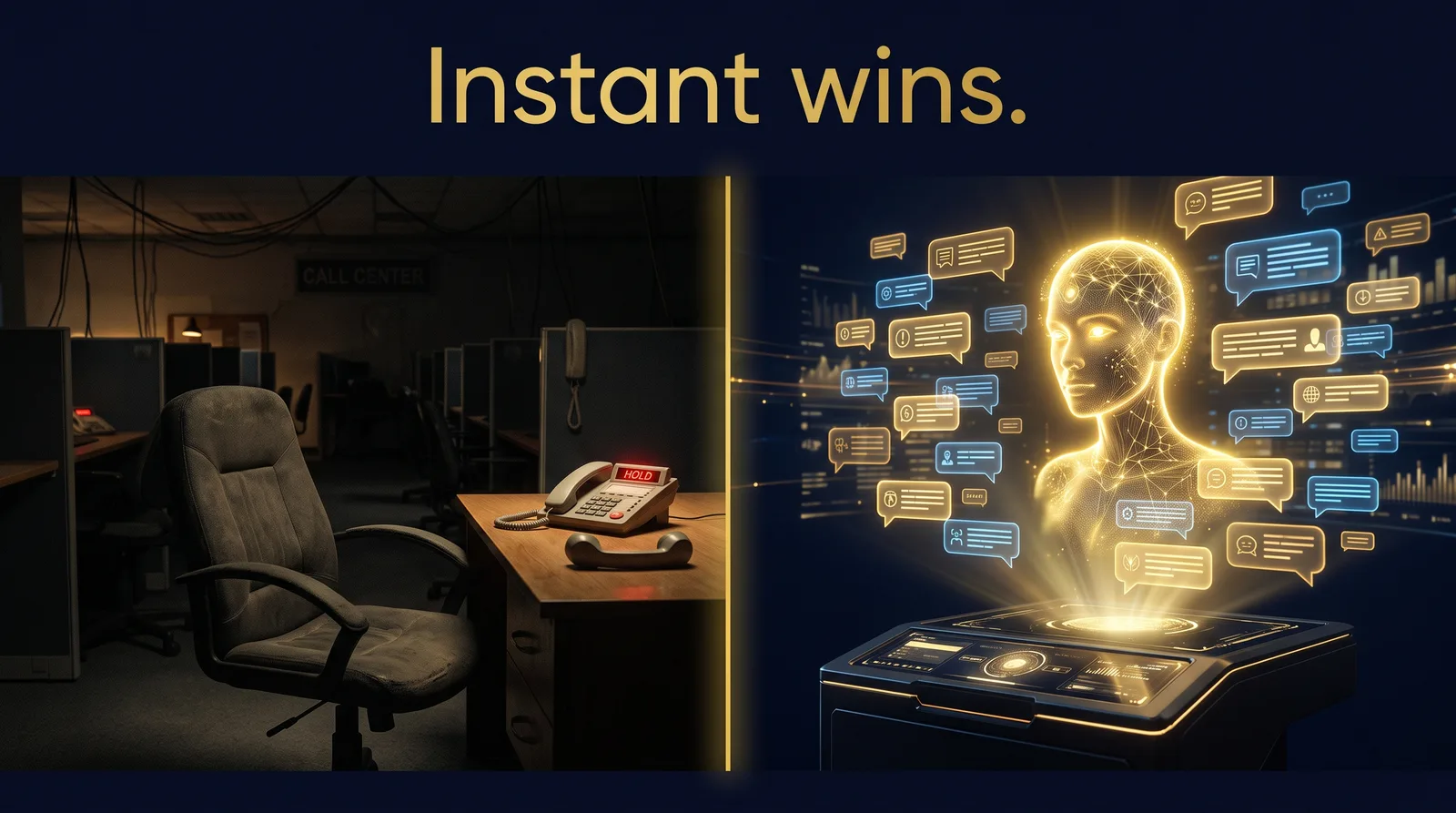
You already know the phone needs coverage. The question is what kind: an AI receptionist that answers and acts on its own, or an answering service staffed by people who take messages. The two get lumped together, but they are different tools that end in different places. One ends with a note about the call. The other ends with an appointment on your calendar.
This guide lays out the AI receptionist vs answering service comparison honestly: what each one actually is, what each costs, where live humans still clearly win, and the single question that settles the decision for most owners.
What each one actually is
An answering service is a call center. Real people answer under your business name, follow a script you approved, take a message, and pass it along by email, text, or a portal. You are billed for their time, per minute or per call. Some higher-end services do more, like legal intake or call transfers, but the core product is message-taking: the caller talks to a person, and you get a summary.
An AI receptionist is software that answers the call itself with a real-time voice. It holds the conversation, answers questions from your business information, asks qualifying questions, and when the caller wants in, it books the appointment directly on your calendar during the call, then texts a confirmation. Most are priced flat per month rather than metered, and many also cover text messages, web chat, and social DMs in the same system.
The cleanest shorthand: an answering service is a relay. It moves information from the caller to you. An AI receptionist is a doer. It finishes the task the caller called about, without waiting for you.
Head-to-head: the eight things that matter
| What matters | AI receptionist | Human answering service |
|---|---|---|
| Cost basis | Flat monthly fee, roughly $79–499/mo across the market | Per minute or per call; the bill tracks talk time |
| 24/7 coverage | Always on, holidays included, at no extra cost | Available on many plans, but every after-hours call still bills minutes |
| Speed to answer | Picks up immediately and handles simultaneous calls | Callers can wait in a queue when the center is busy |
| Consistency | Same answers, same tone, on call one and call one thousand | Varies by receptionist, shift, and how well they know your business |
| Can it book the appointment? | Yes, on your real calendar mid-call, with a confirmation text | Usually no; it takes a message for you to act on later |
| Texts, web chat, DMs | Often included in one system | Phone only, with rare exceptions |
| Multilingual | Common; can switch languages mid-conversation | Depends on who is staffed that shift |
| Weird or complex calls | Falls back: takes a message, alerts you, or hands off to a human | Handles nuance and emotion better; this is where people shine |
Two rows deserve a closer look. The booking row is the whole ballgame for many businesses, and it gets its own section below. And the last row is real: on a strange, sensitive, or complicated call, a trained human is still the better listener. An honest AI vendor will tell you that, and a good AI is built to hand those calls off rather than bluff through them.
What each one really costs
Human answering services bill for human time, which is fair. People cost money. As of August 2026, per vendor pricing pages, Ruby runs $250 per month for 50 minutes up to $1,725 for 500 minutes, which works out to roughly $3.45 to $5 per minute. Smith.ai's human receptionist plans run $300 to $2,100 per month, with overage at $8.50 to $11.50 per call.
Do the arithmetic on one ordinary call. A friendly four-minute conversation at those per-minute rates uses about $14 to $20 of plan time. That is not a criticism, just the shape of the pricing: your bill rises with your call volume, so a busy month for the business is an expensive month for the phone.
AI receptionists flip that. Plans are flat, in a market band of roughly $79 to $499 per month. As of August 2026, per vendor pricing pages, Goodcall charges $79 to $249 per agent with unlimited minutes, and Smith.ai's own AI receptionist plans run $0 to $500 per month by call volume. Velonyx runs $129 to $499 per month depending on channels (web chat only, up through AI voice calls), with no setup fee and the build financed into the first 12 payments; the details are on the financing page and the full tiers on the pricing section. After month 12 the price drops to $70 to $350, because at that point you own the entire system: code, phone number, database, everything. No answering service, and no other AI vendor, transfers ownership that way. How it works is on the ownership page.
One honest caveat: at the very bottom of the market, metered AI plans exist too (Dialzara from $29, Rosie from $49, as of August 2026 per vendor pricing pages). If you truly get a handful of calls a month, cheap and metered can beat flat and capable. More on that in the FAQ.
The deciding lens: message taken vs. appointment booked
Here is the question that settles the AI vs live answering service debate for most owners: when the call ends, what exists?
With an answering service, what exists is a message. "Maria called about a color appointment, wants Saturday, please call her back." Someone still has to do the calling back, and Maria still has to pick up when they do. The work has been recorded, not done.
With a good AI receptionist, what exists is a calendar entry and a confirmation text. Maria asked for Saturday, the AI checked the calendar, offered 10:30 or 2:00, booked 2:00, and texted her the details before she hung up. Nothing is left on your plate.
That difference holds across businesses. The law office caller wants a consultation slot, not a promise of a callback. The restaurant caller wants the private room actually reserved. The accounting client wants fifteen minutes on the books before a deadline. In each case the caller's real request is an appointment, and only one of these two options can grant it on the spot.
So look at what your calls mostly are. If they are mostly "book me in," this lens alone answers the question. If they are mostly nuanced, sensitive, or unpredictable, keep reading, because that is where humans earn their rates.
Where humans still win, and how to get both
An honest comparison includes this section.
Genuine emergencies. A caller in real distress needs triage, calm, and improvisation. A person can depart from every script; software departs from scripts far less gracefully.
High-emotion calls. An upset client, a caller to a law office mid-crisis, a sensitive health or family matter. A trained human reads tone and adapts in ways AI still cannot fully match.
Complex judgment. Negotiating, weighing exceptions, giving layered "it depends" answers. Software should not be making those calls, and the good ones are configured not to try.
Callers who refuse bots. Some people will not talk to software, period. If your clientele skews that way, a human service keeps them on the line.
One more honest note: you might not need either. If you get a few calls a week and reliably return them the same day, voicemail plus discipline costs nothing.
You also do not have to choose in absolutes. A sensible middle exists: AI as the first line, human takeover when it matters. The AI answers instantly, books the routine majority, and flags the calls that need a person. Velonyx builds this in as a Take-Over button in the owner's phone portal: watch a conversation live, tap, and now you are the one talking. Other setups pair an AI front line with an answering service used only for escalations, which shrinks the per-minute human bill to the calls that genuinely need a human.
Will callers know it's an AI?
Yes. And they should.
Modern AI voices are natural enough that some callers will not notice, but you should not aim for that. Several states already require businesses to disclose when a caller is talking to an AI, and call transcription generally carries disclosure requirements of its own. A reputable vendor builds this in rather than treating it as optional. Velonyx's receptionist identifies itself as an AI at the start of every call, on every plan.
Disclosure is also just better business. What callers resent is not a synthetic voice. It is being unhelped: the hold music, the phone tree, the "let me take your name and number." A caller who gets picked up on the first ring, gets a real answer, and hangs up with a confirmed appointment has had a good phone experience, and knowing an AI provided it does not spoil that. Being deceived would.
If you want to feel this rather than take it on faith, call one. The Velonyx Playground is a live AI receptionist you can phone, text, or chat with right now, no signup. Notice how quickly "is this a robot?" gives way to "can it help me?"
FAQ
Will callers hang up when they realize it's an AI?
Some will. There is no honest way to promise zero hang-ups; a few people will always prefer a person, and a small number will hang up on anything synthetic. But the practical comparison is not AI versus a perfect human standing by. It is AI versus voicemail, a hold queue, or a message-taker who cannot answer the caller's question.
Judge it with your own ears rather than anyone's marketing. Call the playground and ask it something a customer would ask. Then decide whether you would have stayed on the line.
What happens when the AI can't handle a call?
A good AI receptionist fails gracefully instead of bluffing. Depending on setup, it takes a detailed message and texts it to you immediately, offers a callback, or hands the call to a human. With Velonyx, you can watch any conversation in your portal and tap Take-Over to step in live.
Whichever vendor you evaluate, ask to see the failure path, not just the happy path. The demo where everything goes right tells you the least.
Is an answering service cheaper if I get very few calls?
Sometimes, yes. If you get a handful of short calls a month, a small metered plan can cost less than a mid-tier flat AI subscription, and voicemail costs nothing at all. Flat AI pricing earns its keep as volume grows, and when what you need from the call is a booking rather than a message.
Run your real numbers: estimate your monthly call minutes, multiply by roughly $3.45 to $5 per minute (Ruby's range as of August 2026, per vendor pricing pages), and compare that to a flat plan.
Can I use both together?
Yes, and it is often the right answer. Common patterns: AI as the 24/7 first line with a human service reserved for escalations, or humans during business hours with the AI covering nights and weekends. Because answering services bill per minute or per call, letting the AI absorb the routine volume shrinks the human bill to only the calls that need a person.
How fast is setup for each?
Both are quick compared to hiring. An answering service needs your account details and a script to approve, typically days rather than weeks. An AI receptionist needs your business information, a calendar connection, and call forwarding; Velonyx builds and launches yours with no setup fee, with the build cost financed into the first 12 months. Neither should take long, and you should be skeptical of any setup timeline measured in months.